
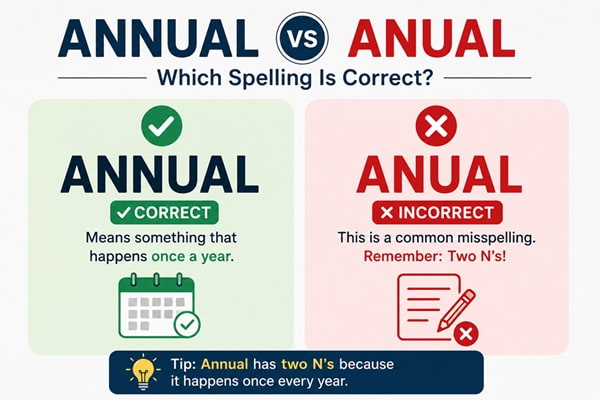
Spelling mistakes often happen with words we use regularly. One of the most common examples is the confusion between annual vs anual. Many people write “anual” in emails, reports, school assignments, business documents, and even website content. The problem is simple: only one of these spellings is correct.
If you have ever wondered whether to write annual or anual, the answer is straightforward. Annual is the correct spelling, while anual is a misspelling. Despite the simplicity of the rule, thousands of people search for this spelling question every month because the mistake appears so frequently.
Understanding why the confusion exists, how to remember the correct spelling, and when to use the word properly can help improve your writing and prevent embarrassing errors. Whether you are a student, professional, business owner, or content writer, mastering this commonly misspelled word is worth the effort.
Contents
- 1 Annual or Anual: Which One Is Correct?
- 2 What Does Annual Mean?
- 3 Why Do People Misspell Annual as Anual?
- 4 The Origin of the Word Annual
- 5 Common Situations Where Annual Is Used
- 6 Annual in Business Writing
- 7 Annual in Education
- 8 Annual in Finance
- 9 Annual in Everyday Life
- 10 Easy Trick to Remember the Correct Spelling
- 11 Common Phrases That Use Annual
- 12 Annual as an Adjective
- 13 Can Annual Be Used as a Noun?
- 14 Annual vs Yearly: Are They the Same?
- 15 Common Mistakes Related to Annual
- 16 Why Correct Spelling Matters
- 17 How Search Engines View Spelling Accuracy
- 18 Frequently Asked Questions About Annual vs Anual
- 19 Final Thoughts
Annual or Anual: Which One Is Correct?
The correct spelling is annual.
The spelling anual is incorrect and should not be used in formal or informal writing.
Correct:
Annual report
Annual meeting
Annual income
Annual leave
Annual celebration
Incorrect:
Anual report
Anual meeting
Anual income
Anual leave
Anual celebration
Whenever you need a word that refers to something happening once every year, annual is the proper choice.
What Does Annual Mean?
The word annual refers to something that occurs once a year or lasts for a year.
It can describe events, reports, payments, subscriptions, celebrations, budgets, meetings, and many other activities connected to a yearly cycle.
For example, a company may publish an annual report summarizing its performance over the previous year. A school may hold an annual function to celebrate student achievements. A magazine subscription might require an annual payment.
In every case, the word connects directly to a one year period.
Why Do People Misspell Annual as Anual?
The mistake usually happens because of pronunciation.
When people say the word aloud, the double “n” is not strongly emphasized. As a result, many writers assume the word contains only one “n” and write “anual.”
English contains many words with double letters that are easy to overlook. Since the sound remains almost the same, writers often remove one of the repeated letters without realizing the spelling has become incorrect.
Fast typing can also contribute to the error. Someone working quickly may accidentally skip one of the letters and fail to notice the mistake before publishing or sending the text.
Another factor is autocorrect dependence. Many writers rely heavily on spell checking tools. When writing on platforms without automatic correction, spelling mistakes become more common.
The Origin of the Word Annual
Understanding a word’s history often makes spelling easier to remember.
Annual comes from the Latin word “annus,” which means “year.”
Over time, the term evolved through different languages before becoming the English word annual. The double “n” originates from its historical roots.
Knowing that annual is connected to the Latin word annus helps explain why the correct spelling contains two “n” letters rather than one.
Language history often provides clues that make spelling patterns easier to understand.
Common Situations Where Annual Is Used
Annual appears in many professional, academic, financial, and everyday contexts.
Businesses frequently use the word when discussing yearly performance, revenue, budgets, and strategic planning.
Schools and colleges often refer to annual functions, annual examinations, annual sports events, and annual reports.
Government organizations publish annual statistics and annual financial statements.
Individuals encounter the term through annual subscriptions, annual memberships, annual health checkups, and annual insurance premiums.
Because the word appears across so many fields, understanding its correct spelling becomes especially important.
Annual in Business Writing
Business communication relies heavily on accuracy. A simple spelling mistake can affect credibility.
Companies regularly produce annual reports that provide shareholders and stakeholders with important financial information.
Managers discuss annual budgets when planning future expenses and investments.
Human resource departments often evaluate employee performance during annual reviews.
Marketing teams may create annual strategies that guide campaigns throughout the year.
Using the correct spelling in professional documents helps maintain a polished and trustworthy image.
Annual in Education
Educational institutions use annual in a wide variety of situations.
Students participate in annual cultural events, science fairs, competitions, and sports programs.
Schools often distribute annual reports that summarize achievements, academic results, and institutional developments.
Many colleges organize annual gatherings that bring together current students and alumni.
Teachers may refer to annual assessments when evaluating long term student progress.
Since students frequently encounter the word, learning the correct spelling early helps improve writing skills.
Annual in Finance
Financial discussions frequently involve annual calculations.
Investors examine annual returns to measure investment performance.
Businesses review annual profits and annual expenses when assessing financial health.
Banks may quote annual interest rates on loans and savings accounts.
Insurance companies calculate annual premiums based on coverage and risk factors.
Financial documents require precision, making correct spelling especially important in this field.
Annual in Everyday Life
Outside business and education, annual remains a common part of daily language.
Many families celebrate annual traditions such as reunions, vacations, and holiday gatherings.
Doctors often recommend annual medical checkups to monitor overall health.
Clubs and organizations collect annual membership fees from participants.
Streaming services, software providers, and professional associations commonly offer annual subscription plans.
Because the term appears so frequently, recognizing its correct spelling becomes second nature with practice.
Easy Trick to Remember the Correct Spelling
One of the simplest ways to remember annual is to focus on the word year.
Annual comes from a word related to a year, and its historical root contains two “n” letters.
Another helpful trick is to remember that important yearly events deserve an extra “n.”
Think of the phrase:
“Annual has two Ns because it happens every year, not every once in a while.”
Memory tricks may seem simple, but they can effectively prevent future mistakes.
Common Phrases That Use Annual
Many expressions include the word annual.
Annual report is one of the most common business phrases.
Annual meeting appears regularly in corporate and organizational settings.
Annual income is frequently used in employment and financial discussions.
Annual leave refers to paid vacation time provided by employers.
Annual budget helps organizations manage financial planning.
Annual conference describes large gatherings that occur once every year.
Annual celebration refers to recurring events marking special occasions.
Recognizing these common phrases reinforces the correct spelling through repeated exposure.
Annual as an Adjective
Grammatically, annual functions primarily as an adjective.
An adjective describes a noun.
For example:
Annual meeting
Annual budget
Annual payment
Annual festival
Annual review
In each example, annual describes something related to a yearly occurrence.
Understanding its grammatical role can help writers use the word more confidently.
Can Annual Be Used as a Noun?
Yes, although less common.
In gardening and botany, an annual can refer to a plant that completes its life cycle within one growing season.
These plants germinate, grow, flower, produce seeds, and die within a single year.
Gardeners often classify plants as annuals, biennials, or perennials depending on their life cycles.
This botanical meaning differs from the adjective form but follows the same yearly concept.
Annual vs Yearly: Are They the Same?
In many situations, annual and yearly have similar meanings.
Both words generally refer to something occurring once every year.
For example:
Annual meeting
Yearly meeting
Annual subscription
Yearly subscription
Annual income
Yearly income
Despite the similarity, annual often sounds more formal and is more common in business, academic, and professional writing.
Yearly tends to appear more frequently in casual conversation.
Writers can usually choose either option depending on tone and context.
Common Mistakes Related to Annual
Several spelling errors occur regularly.
Anual is the most frequent mistake.
Some writers accidentally type annnual by adding an extra “n.”
Others may write anualy instead of annually.
The correct forms are:
Annual
Annually
Paying attention to double letters helps eliminate many of these errors.
Proofreading remains one of the best ways to catch spelling mistakes before publication.
Why Correct Spelling Matters
Some people view spelling errors as minor issues. However, readers often form opinions based on writing quality.
A misspelled word in a resume may create a negative first impression.
Business proposals containing spelling mistakes can appear less professional.
Website content with repeated errors may reduce trust among visitors.
Academic assignments benefit from careful proofreading because accuracy contributes to overall quality.
Correct spelling strengthens credibility and demonstrates attention to detail.
Also Read : IDTS Meaning in Chat: What Does IDTS Mean in Text Messages and Online Conversations?
How Search Engines View Spelling Accuracy
Search engines aim to provide users with relevant and trustworthy content.
Well written pages generally create a better user experience.
Although a single spelling mistake will not ruin a webpage, frequent errors can affect readability and user trust.
Content creators, bloggers, and businesses benefit from using correct spelling throughout their articles.
Readers tend to spend more time on content that appears polished and professional.
Maintaining accuracy supports both user satisfaction and content quality.
Frequently Asked Questions About Annual vs Anual
Many people wonder whether anual is accepted in any form of English.
The answer is no. Standard English recognizes annual as the correct spelling.
Another common question concerns whether annual always refers to exactly one year.
Generally, yes. The term describes something occurring once per year or relating to a yearly period.
Some writers also ask whether annual and annually are interchangeable.
They are related but serve different grammatical functions. Annual is usually an adjective, while annually functions as an adverb.
Understanding these distinctions improves writing accuracy.
Final Thoughts
The debate between annual and anual has a simple answer. Annual is the correct spelling, while anual is always incorrect. The confusion usually occurs because the double “n” is easy to overlook when speaking or typing quickly.
Learning the correct form helps improve professional writing, academic work, business communication, and everyday correspondence. Since annual appears in reports, meetings, budgets, subscriptions, events, and financial documents, mastering its spelling offers long term benefits.
Whenever you encounter the choice between annual vs anual, remember the rule: yearly activities deserve two “n” letters. Using the correct spelling consistently will make your writing clearer, stronger, and more professional.