
A short message can sometimes leave people completely confused. You open a chat, read a reply that says “IGU,” and suddenly find yourself wondering what those three letters mean. Internet slang changes quickly, and new abbreviations appear across social media, texting apps, gaming communities, and online conversations every day.
Among the many acronyms used online, IGU has gained attention because it carries a positive and supportive meaning. Unlike some abbreviations that express frustration, sarcasm, or disagreement, IGU is often used to show understanding, reassurance, and emotional support.
Knowing the meaning of IGU can help you understand conversations more clearly and respond appropriately. Whether you encounter it in a text message, social media comment, direct message, or group chat, understanding this acronym makes online communication much easier.
Contents
- 1 What Does IGU Mean in Text?
- 2 Why IGU Became Popular
- 3 Understanding the Real Meaning Behind IGU
- 4 IGU Meaning in Text Messages
- 5 IGU Meaning on Social Media
- 6 How Younger Generations Use IGU
- 7 Different Situations Where IGU Can Be Used
- 8 IGU as a Sign of Emotional Support
- 9 Examples of IGU in Everyday Conversations
- 10 IGU in Friendships
- 11 IGU in Relationships
- 12 IGU in Online Gaming
- 13 Is IGU Always Positive?
- 14 How IGU Differs From Similar Acronyms
- 15 Should You Use IGU in Professional Communication?
- 16 Why Internet Slang Continues to Evolve
- 17 Common Misunderstandings About IGU
- 18 The Future of IGU in Digital Communication
- 19 Why Understanding IGU Matters
- 20 Final Thoughts
What Does IGU Mean in Text?
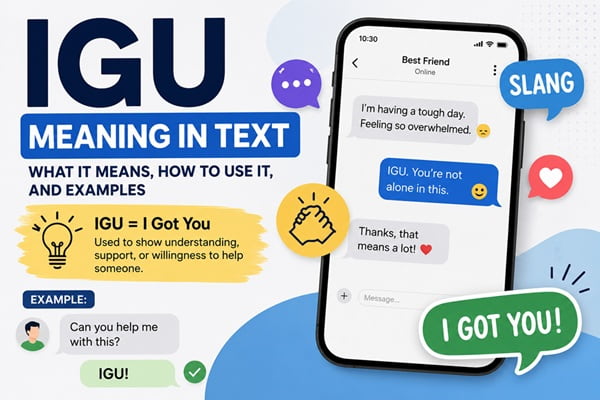
The most common meaning of IGU is “I Got You.”
People use this phrase when they want to tell someone they understand them, support them, will help them, or are willing to take care of a situation.
The expression creates a feeling of trust and reassurance. Instead of writing the complete phrase “I got you,” users shorten it to IGU for faster communication.
Someone who says IGU is essentially communicating:
“I understand.”
“I’ll help you.”
“I’ll take care of it.”
“You can count on me.”
“Don’t worry.”
The exact meaning depends on the context of the conversation, but the overall message remains positive and supportive.
Why IGU Became Popular
Online communication often rewards speed.
People prefer short responses that communicate complete thoughts without requiring long explanations. Acronyms help achieve that goal.
IGU became popular because it expresses a meaningful message using only three letters. Rather than typing an entire sentence, users can quickly reassure someone with a simple abbreviation.
Messaging culture also encourages emotional shorthand. Friends, family members, coworkers, and online communities often use abbreviations that feel natural and conversational.
Since “I got you” is already a common phrase in everyday speech, turning it into IGU was a natural evolution.
Understanding the Real Meaning Behind IGU
Many internet abbreviations simply save time. IGU does more than that.
The phrase carries an emotional element. It often communicates reliability, trust, and willingness to help.
Imagine a friend saying:
“I forgot my notes for class.”
A response of “IGU” suggests the friend will share notes or provide assistance.
Consider another situation:
“I’m stressed about tomorrow’s presentation.”
Someone replying with “IGU” may be expressing support and understanding.
Because the phrase often involves helping or reassuring another person, it tends to create positive interactions.
IGU Meaning in Text Messages
Text messaging remains one of the most common places where IGU appears.
Friends frequently use it when discussing plans, asking for favors, or offering assistance.
A conversation might look like this:
Person A: “Can you pick me up after work?”
Person B: “IGU.”
The response immediately communicates agreement and support.
Another example:
Person A: “Can you send me those photos later?”
Person B: “IGU.”
Instead of writing a longer reply, the abbreviation quickly confirms that the request will be handled.
IGU Meaning on Social Media
Social media platforms encourage fast interactions between users.
Comments, replies, direct messages, and private conversations often contain abbreviations that help people communicate efficiently.
Someone might post about a challenge they are facing.
A friend may respond with “IGU.”
That simple reply shows empathy and willingness to help without requiring a lengthy explanation.
Social media conversations often move quickly, making short expressions like IGU especially useful.
How Younger Generations Use IGU
Teenagers and young adults frequently adopt new internet slang before older generations become familiar with it.
IGU has become popular among younger users because it combines convenience with emotional connection.
Many young people use it naturally in daily conversations.
The abbreviation often appears when discussing school, friendships, relationships, work responsibilities, and personal challenges.
Since younger users spend significant time communicating through messaging apps, shorthand expressions become part of their everyday language.
Different Situations Where IGU Can Be Used
One reason for the popularity of IGU is its flexibility.
The phrase works in many different contexts.
Someone offering help may use IGU.
A friend expressing understanding may use IGU.
A teammate agreeing to complete a task may use IGU.
A family member providing reassurance may use IGU.
Although the exact meaning varies slightly depending on the situation, the central idea remains consistent: support, understanding, or assistance.
IGU as a Sign of Emotional Support
Digital conversations sometimes lack emotional cues.
Facial expressions, tone of voice, and body language are absent in text based communication.
Acronyms like IGU help fill that gap.
When someone shares a problem, concern, or frustration, receiving an IGU response can provide reassurance.
The phrase tells the other person they are not facing the situation alone.
That emotional connection explains why the abbreviation continues to grow in popularity.
Examples of IGU in Everyday Conversations
Understanding real examples makes the meaning clearer.
Friend 1: “I missed today’s lecture.”
Friend 2: “IGU. I’ll send my notes.”
In this example, the phrase communicates help.
Friend 1: “I’m nervous about my interview.”
Friend 2: “IGU. You’re going to do great.”
Here, the abbreviation provides encouragement.
Friend 1: “Can you cover my shift tomorrow?”
Friend 2: “IGU.”
The response indicates agreement and support.
Each situation demonstrates how the acronym adapts naturally to different conversations.
IGU in Friendships
Friendships often rely on trust, reliability, and mutual support.
IGU fits perfectly within those values.
A person using the phrase usually wants to reassure a friend that assistance is available when needed.
Because the expression feels casual and genuine, many people prefer it over longer responses.
The simplicity of IGU often makes the message feel more natural and conversational.
Strong friendships frequently involve these small moments of support, and the abbreviation captures that idea effectively.
IGU in Relationships
Romantic relationships also benefit from supportive communication.
Partners often use phrases that express understanding and reliability.
IGU can serve as a quick way to communicate emotional support during conversations.
Someone discussing a stressful day may receive an IGU response that signals empathy and encouragement.
Short expressions can sometimes carry significant emotional meaning when used in the right context.
IGU in Online Gaming
Gaming communities frequently use abbreviations because communication often happens rapidly.
Players need quick ways to coordinate strategies and help teammates.
IGU sometimes appears when one player agrees to assist another.
A teammate may request backup during gameplay.
Another player might respond with “IGU.”
The abbreviation efficiently communicates support without interrupting the flow of the game.
Is IGU Always Positive?
Most uses of IGU carry positive intentions.
The phrase generally expresses help, support, understanding, or agreement.
However, like many forms of internet slang, tone can depend on context.
Occasionally, users may employ the phrase sarcastically, especially among close friends.
Even in those situations, surrounding messages usually make the intended meaning clear.
The overwhelming majority of IGU usage remains positive and supportive.
How IGU Differs From Similar Acronyms
Internet language contains many abbreviations that appear similar but serve different purposes.
IDK means “I Don’t Know.”
IMO means “In My Opinion.”
TBH means “To Be Honest.”
SMH means “Shaking My Head.”
IGU stands apart because it focuses on reassurance and support.
Rather than expressing uncertainty, opinion, or frustration, it communicates understanding and willingness to help.
That distinction makes it particularly valuable in personal conversations.
Should You Use IGU in Professional Communication?
Professional environments usually require more formal language.
While IGU works well among friends and casual contacts, business communication generally benefits from complete sentences.
Instead of writing IGU in a workplace email, someone might write:
“I can handle that.”
“I’ll take care of it.”
“I understand.”
“I’ll help with that.”
Formal language reduces the risk of misunderstanding and maintains professionalism.
Knowing when to use internet slang is just as important as knowing what it means.
Why Internet Slang Continues to Evolve
Language adapts to the needs of its users.
Digital communication encourages efficiency, creativity, and speed.
As new platforms emerge, users develop fresh expressions that fit modern communication habits.
Some acronyms disappear after a short period.
Others remain popular because they express useful ideas clearly and efficiently.
IGU belongs to the second category. Its meaning is easy to understand, emotionally positive, and practical in many situations.
Those qualities contribute to its continued popularity.
Common Misunderstandings About IGU
People encountering the acronym for the first time sometimes struggle to interpret its meaning.
Without context, three letters can appear confusing.
Some users mistakenly assume IGU represents a technical term, company name, or unrelated phrase.
Most online conversations use IGU to mean “I Got You.”
Understanding that primary meaning eliminates confusion in the majority of situations.
Context remains the best guide when interpreting internet slang.
Also Read : Annual vs Anual: Which Spelling Is Correct? Complete Grammar Guide
The Future of IGU in Digital Communication
Many online abbreviations come and go as trends change.
Expressions that communicate meaningful emotions often survive longer than purely trendy slang.
IGU succeeds because it provides a quick way to express support, understanding, and reliability.
Those concepts remain valuable regardless of changes in technology or communication platforms.
As long as people continue seeking efficient ways to connect with others, abbreviations like IGU will likely remain relevant.
Its positive message gives it staying power that many internet slang terms never achieve.
Why Understanding IGU Matters
Internet conversations contain thousands of abbreviations, but not all of them carry the same significance.
IGU stands out because it represents more than convenience.
The phrase communicates trust, empathy, assistance, and emotional support.
Recognizing its meaning helps users navigate digital conversations with greater confidence.
Whether it appears in a text message, social media comment, gaming chat, or private conversation, understanding IGU allows you to interpret the message accurately.
Final Thoughts
IGU means “I Got You,” a popular internet abbreviation used to express understanding, support, reassurance, or willingness to help. The acronym has become common across text messages, social media platforms, online gaming communities, and everyday digital conversations.
People use IGU because it communicates a meaningful message in just three letters. Behind the abbreviation lies a simple but powerful idea: someone is willing to help, listen, understand, or stand by another person. As online communication continues to evolve, supportive expressions like IGU remain an important part of how people connect and communicate.