Few spelling mistakes appear as frequently as useage. Many people type it confidently, only to discover later that spell check highlights it as an error. The confusion is understandable. Since words like mileage, baggage, and postage end with “age,” it seems logical to assume that useage follows the same pattern.
English, however, does not always follow predictable rules. Some words evolve differently, and usage is one of them.
Students, writers, bloggers, professionals, and even native English speakers regularly search for the difference between usage and useage. The good news is that the answer is simple. Only one spelling is correct in standard English.
Understanding why usage is correct and useage is incorrect can help improve writing accuracy, strengthen communication skills, and prevent a common mistake that appears in emails, articles, reports, and academic assignments.
This guide explores everything about usage or useage, including definitions, grammar rules, examples, common mistakes, historical background, pronunciation, and practical writing tips.
Contents
- 1 Is It Usage or Useage?
- 2 What Does Usage Mean?
- 3 Why Do People Write Useage?
- 4 The Origin of the Word Usage
- 5 Why Usage Is Grammatically Correct
- 6 Common Situations Where Usage Appears
- 7 Usage in Everyday English
- 8 Usage in Grammar and Language
- 9 Usage in Technology
- 10 Usage in Business
- 11 Usage in Education
- 12 Usage in Marketing
- 13 Common Examples of Correct Usage
- 14 Examples of Incorrect Useage
- 15 Why Spell Check Flags Useage
- 16 Pronunciation of Usage
- 17 Memory Trick for Usage
- 18 Usage vs Use
- 19 Why This Mistake Is So Common
- 20 How Writers Can Avoid the Error
- 21 Usage in Academic Writing
- 22 Usage in Professional Communication
- 23 Why Correct Spelling Matters
- 24 Frequently Asked Questions About Usage and Useage
- 25 Final Thoughts
Is It Usage or Useage?
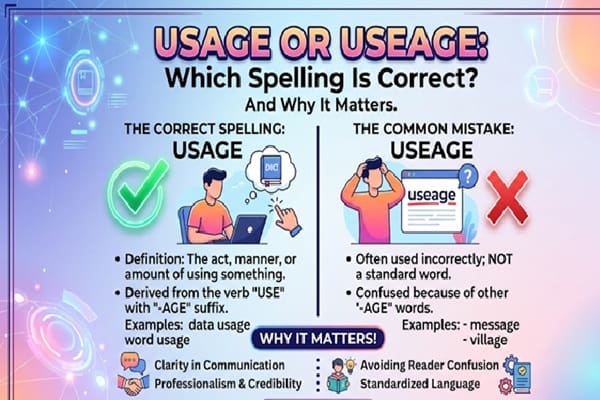
The correct spelling is usage.
The spelling useage is incorrect and is not recognized as a standard English word.
Correct:
Usage
Incorrect:
Useage
Whenever you are referring to the way something is used, accepted language practices, or frequency of use, the proper word is always usage.
For example:
“The usage of smartphones has increased.”
“Correct grammar usage improves communication.”
“Dictionary usage varies by region.”
In all these examples, usage is the only correct spelling.
What Does Usage Mean?
The word usage refers to the way something is used or the accepted manner in which language, tools, products, or systems are employed.
Usage can describe behavior, habits, patterns, customs, or language practices.
Examples include:
Internet usage
Water usage
Language usage
Energy usage
Software usage
Daily usage
The word helps explain how people interact with something over time.
Why Do People Write Useage?
The mistake usually comes from spelling patterns found in other English words.
Many common words end with:
Age
Mileage
Baggage
Postage
Breakage
Because of these examples, writers often assume use should become useage.
English developed differently in this case. The word evolved into usage rather than useage.
As a result, useage remains a common misspelling rather than an accepted alternative.
The Origin of the Word Usage
Understanding a word’s history often makes spelling easier to remember.
Usage comes from older French and Latin language roots associated with use, custom, practice, and habit.
Over time, English adopted the spelling usage without adding the extra “e.”
Language evolution frequently creates words that do not perfectly follow modern spelling expectations.
Usage became the accepted form and has remained standard for centuries.
Why Usage Is Grammatically Correct
English dictionaries, grammar guides, educational institutions, and style manuals consistently recognize usage as the correct spelling.
The word functions as a noun.
Examples include:
“The usage rate increased.”
“Monitor your data usage.”
“Language usage differs between regions.”
Each sentence uses usage correctly as a noun describing a pattern or manner of use.
Since useage is not recognized as a standard English word, it should never replace usage in formal writing.
Common Situations Where Usage Appears
The word appears across many industries and everyday conversations.
Technology companies track software usage.
Utility providers monitor water usage.
Educators discuss language usage.
Businesses analyze customer usage patterns.
Researchers study internet usage trends.
The broad application of the term explains why people encounter it frequently.
Usage in Everyday English
Daily conversations often include the word without people realizing it.
Examples include:
“My phone usage has increased.”
“Reduce electricity usage to save money.”
“Social media usage continues growing.”
“Screen usage affects sleep habits.”
These examples demonstrate how naturally the word fits into everyday communication.
Usage in Grammar and Language
One of the most important meanings of usage relates to language itself.
Grammar experts often discuss language usage when explaining how words, phrases, and expressions are commonly used.
For example:
Formal usage
Informal usage
Regional usage
Modern usage
Traditional usage
Language usage helps determine whether expressions sound natural to native speakers.
Usage in Technology
Technology companies rely heavily on usage data.
Software developers analyze:
App usage
Website usage
Feature usage
Device usage
User behavior
These measurements help organizations understand how people interact with products and services.
Because technology is such a major part of modern life, usage has become an increasingly important term.
Usage in Business
Businesses frequently monitor usage patterns to improve products and services.
Examples include:
Customer usage reports
Subscription usage tracking
Resource usage analysis
Service usage statistics
Operational usage reviews
These insights help organizations make better decisions and improve customer experiences.
Usage in Education
Teachers and students encounter the word regularly.
Academic discussions often include:
Word usage
Grammar usage
Vocabulary usage
Sentence usage
Language usage rules
Understanding proper usage helps students become stronger communicators and writers.
Usage in Marketing
Marketing professionals analyze how customers interact with products.
They often study:
Product usage
Platform usage
Consumer usage habits
Mobile usage behavior
Digital usage trends
This information helps businesses create more effective strategies.
Common Examples of Correct Usage
Looking at real examples helps reinforce proper spelling.
Correct examples:
“Internet usage increased dramatically.”
“Monitor your energy usage each month.”
“Proper word usage improves clarity.”
“The software tracks user usage.”
“Data usage exceeded the monthly limit.”
Each sentence demonstrates the correct form.
Examples of Incorrect Useage
These examples contain spelling errors:
“Internet useage increased.”
“Monitor your energy useage.”
“Word useage matters.”
“Data useage exceeded the limit.”
Although the meaning remains understandable, the spelling is incorrect.
Professional writing should always avoid useage.
Why Spell Check Flags Useage
Most spell check tools recognize useage as a misspelling.
Because the word does not exist in standard English dictionaries, writing software automatically suggests usage instead.
Grammar tools, educational platforms, and professional editing systems all follow the same standard.
This consistency reinforces usage as the accepted spelling.
Pronunciation of Usage
Another source of confusion involves pronunciation.
Usage is commonly pronounced:
YOO sij
The spoken form may sound slightly different depending on regional accents.
Despite pronunciation variations, the spelling remains usage.
Adding an extra “e” is never necessary.
Memory Trick for Usage
A simple memory trick can help.
Think of the base word use.
The correct noun form is usage.
Avoid inserting an extra “e” between use and age.
Whenever you feel tempted to write useage, remember that dictionaries only recognize usage.
Usage vs Use
Many learners also confuse usage and use.
Although related, the words have different functions.
Use can be a noun or a verb.
Examples:
“I use my laptop daily.”
“The use of technology has increased.”
Usage specifically refers to the manner, pattern, or frequency of use.
Examples:
“Internet usage is growing.”
“Monitor your water usage.”
The distinction becomes clearer with practice.
Why This Mistake Is So Common
Several factors contribute to the popularity of the mistake.
English spelling is not always predictable.
Many words ending in “age” encourage incorrect assumptions.
Pronunciation sometimes makes the spelling appear logical.
Writers often rely on sound rather than dictionary verification.
Because of these factors, useage continues appearing in blogs, emails, social media posts, and assignments.
How Writers Can Avoid the Error
Strong writing habits reduce spelling mistakes.
Helpful strategies include:
Using spell check tools
Reading professionally edited content
Consulting dictionaries
Proofreading carefully
Practicing correct spelling regularly
Repeated exposure helps reinforce proper word forms.
Usage in Academic Writing
Academic writing requires precision.
Professors, editors, and researchers expect correct spelling.
Using usage instead of useage helps maintain credibility and professionalism.
A single spelling mistake rarely ruins a paper, but consistent accuracy strengthens overall writing quality.
Students benefit from learning the correct form early.
Also Read : NS Meaning in Text: What Does NS Mean in Gaming, Social Media, and Messages?
Usage in Professional Communication
Business communication often reflects attention to detail.
Emails, reports, presentations, and proposals should always use the correct spelling.
Professional examples include:
“Software usage increased this quarter.”
“Customer usage patterns indicate growth.”
“Monthly usage reports are attached.”
Accurate spelling creates a stronger impression.
Why Correct Spelling Matters
Spelling influences how readers perceive writing.
Accurate spelling:
Builds credibility
Improves readability
Enhances professionalism
Supports clear communication
Reduces misunderstandings
Even small corrections can significantly improve written content.
Frequently Asked Questions About Usage and Useage
Many people ask whether useage is accepted in British English.
The answer is no.
Both American English and British English recognize usage as the correct spelling.
Others wonder whether useage was once correct historically.
Standard dictionaries have consistently favored usage, while useage remains a misspelling.
Some writers ask if useage appears in informal communication.
Although people occasionally write it, the spelling is still considered incorrect.
Final Thoughts
The debate between usage or useage has a simple answer. Usage is the correct spelling, while useage is a common misspelling. Whether you are writing an email, academic paper, blog post, business report, or social media content, usage is the form recognized by dictionaries and grammar experts.
Understanding the difference helps improve writing accuracy and confidence. Since the mistake often comes from understandable spelling assumptions, many people make it without realizing it. Once you learn the rule, remembering the correct spelling becomes much easier.
The next time you need to describe the way something is used, the frequency of use, or accepted language practices, choose usage with confidence.