Contents
- 1 Introduction
- 2 Challenge or Challange: Which One Is Correct?
- 3 What Does Challenge Mean?
- 4 Why Do People Write Challange Instead of Challenge?
- 5 The Origin of the Word Challenge
- 6 Challenge as a Noun
- 7 Challenge as a Verb
- 8 Common Places Where the Word Challenge Appears
- 9 Examples of Challenge in Everyday Sentences
- 10 Why Correct Spelling Matters
- 11 Challenge in Academic Writing
- 12 Challenge in Professional Communication
- 13 Challenge in Personal Development
- 14 Common Spelling Mistakes Related to Challenge
- 15 Easy Tricks to Remember the Correct Spelling
- 16 Challenge vs Similar Words
- 17 Why English Spelling Creates Confusion
- 18 How Teachers Explain the Difference
- 19 Challenge in Digital Communication
- 20 Frequently Asked Questions About Challenge and Challange
- 21 The Importance of Learning Commonly Misspelled Words
- 22 Conclusion
Introduction
A single misplaced letter can change the way readers see your writing. Few spelling mistakes appear as often as challange instead of challenge. The words look similar, sound almost identical, and often slip past writers who are typing quickly.
Students make the mistake in essays. Professionals occasionally miss it in emails. Content creators sometimes publish articles with the wrong spelling. Even experienced English speakers pause for a moment when deciding which version is correct.
The answer is straightforward. Challenge is the correct spelling. Challange is a spelling error.
Understanding why the mistake happens can help you avoid it permanently. This guide explains the difference between challenge and challange, explores the meaning of challenge, examines common usage examples, discusses grammar rules, and provides practical memory tricks that make the correct spelling easy to remember.
Challenge or Challange: Which One Is Correct?
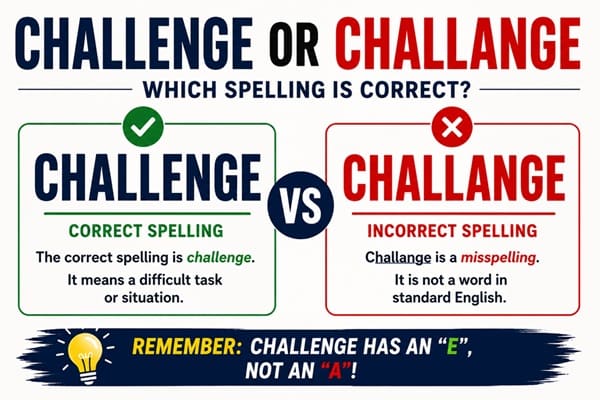
The correct spelling is challenge.
The word challange is not recognized as a standard English word. Dictionaries, grammar guides, academic institutions, and professional writing standards all accept only challenge.
Here is the correct form:
Challenge
Here is the incorrect form:
Challange
Whenever you write the word, use challenge with the letter e in the final syllable.
What Does Challenge Mean?
Challenge is a versatile English word used as both a noun and a verb.
As a noun, it refers to a difficult task, obstacle, test, or situation that requires effort to overcome.
Example:
“Learning a new language can be a challenge.”
As a verb, it means to question, compete against, test, or invite someone to prove something.
Example:
“She challenged the decision made by the committee.”
Because the word appears in so many situations, it has become a common part of everyday communication.
Why Do People Write Challange Instead of Challenge?
Several factors contribute to the mistake.
Pronunciation plays the biggest role. When spoken aloud, challenge and challange sound very similar. The ending does not strongly emphasize whether the vowel is an “e” or an “a.”
Fast typing also increases the likelihood of errors. Many writers focus on getting ideas onto the page rather than carefully checking every letter.
Autocorrect tools catch many spelling issues, but mistakes can still slip through, especially when software settings vary.
Another reason involves patterns in English spelling. Words like change, arrange, and exchange contain the “ange” ending, leading some people to assume challenge follows the same structure.
English spelling often breaks predictable patterns, making confusion understandable.
The Origin of the Word Challenge
Understanding a word’s history often makes its spelling easier to remember.
Challenge comes from older French and Latin roots connected to the idea of calling someone to defend a claim, prove a point, or enter a contest.
Over centuries, the word evolved into the modern English form we use today.
The spelling settled as challenge, and that version became standardized in dictionaries, literature, education, and professional writing.
Because the word has existed for hundreds of years, its spelling is firmly established.
Challenge as a Noun
Most people encounter challenge as a noun.
In this form, it refers to something difficult that requires effort, skill, patience, or determination.
Examples include:
“Completing the marathon was a major challenge.”
“Managing a growing business presents new challenges.”
“Finding enough time for study can be a challenge.”
Many motivational discussions focus on overcoming challenges because the word naturally connects to growth and achievement.
Challenge as a Verb
Challenge also functions as a verb.
When used this way, it often means questioning, testing, competing against, or inviting someone to prove their abilities.
Consider these examples:
“The lawyer challenged the witness’s statement.”
“The athlete challenged the defending champion.”
“The teacher challenged students to think critically.”
Each sentence demonstrates a different meaning while maintaining the core idea of testing or questioning something.
Common Places Where the Word Challenge Appears
Challenge appears in nearly every area of life.
Education uses the term when discussing difficult assignments, exams, and learning goals.
Sports rely on challenge to describe competitions and tests of skill.
Business professionals talk about workplace challenges, market challenges, and leadership challenges.
Technology experts discuss technical challenges and development challenges.
Personal growth conversations often center on overcoming challenges and building resilience.
Because the word is so common, correct spelling becomes especially important.
Examples of Challenge in Everyday Sentences
Real examples help reinforce proper usage.
“Public speaking was once my biggest challenge.”
“Parents often face challenges balancing work and family responsibilities.”
“The company accepted the challenge and launched the project successfully.”
“Researchers continue to challenge old assumptions.”
“Training for the event presented several physical challenges.”
Notice that every example uses the spelling challenge.
No professional publication would use challange.
Why Correct Spelling Matters
Spelling affects credibility.
Readers often form opinions about writing quality within seconds. Obvious spelling errors can reduce confidence in the message, even when the information itself is accurate.
A resume containing challange may appear less polished.
A business proposal with repeated spelling mistakes can create an unprofessional impression.
Academic writing requires particular attention because spelling accuracy contributes to overall evaluation.
Correct spelling demonstrates care, attention to detail, and strong communication skills.
Challenge in Academic Writing
Students frequently use challenge in essays, reports, research papers, and examinations.
Teachers often see the misspelling challange because students write quickly under pressure.
Academic writing benefits from proofreading every assignment before submission.
Common academic phrases include:
Research challenge
Learning challenge
Academic challenge
Social challenge
Economic challenge
Environmental challenge
Seeing the word repeatedly in correct form helps reinforce accurate spelling habits.
Challenge in Professional Communication
Workplace communication depends on clarity.
Emails, reports, presentations, proposals, and policy documents regularly contain the word challenge.
Managers discuss operational challenges.
Teams address project challenges.
Leaders talk about strategic challenges.
Clients describe business challenges.
A misspelled word may distract readers from the main message, making proofreading worthwhile.
Challenge in Personal Development
Personal growth literature frequently uses challenge as a central theme.
Many people view challenges as opportunities to learn, adapt, and improve.
A difficult experience can strengthen problem solving abilities.
A challenging goal often encourages persistence.
Personal development discussions rarely frame challenges as purely negative. Instead, they often emphasize growth through effort and experience.
That positive perspective contributes to the word’s popularity.
Common Spelling Mistakes Related to Challenge
Several spelling variations appear regularly.
Some writers use challange.
Others accidentally type challangee, chalenge, or challlenge.
Despite these variations, only challenge is considered correct standard English.
Spell check software usually identifies these mistakes, but manual review remains important.
Developing familiarity with the correct spelling helps prevent errors before they happen.
Easy Tricks to Remember the Correct Spelling
Memory techniques can make spelling easier.
One useful trick is to focus on the ending.
Challenge ends with “enge.”
Think about the phrase:
“A challenge requires effort.”
Both words contain the letter “e” near the end.
Another method involves repeated exposure. Reading professionally edited books, articles, and publications helps reinforce correct spelling naturally.
Frequent writing practice also improves spelling accuracy over time.
Challenge vs Similar Words
English contains several words that look somewhat similar.
Change is correctly spelled with “ange.”
Arrange also uses “ange.”
Exchange follows the same pattern.
Challenge does not.
That difference often causes confusion because many people expect similar sounding words to follow identical spelling rules.
English spelling does not always work that way.
Learning words individually often proves more reliable than relying on patterns alone.
Why English Spelling Creates Confusion
English developed from multiple language influences.
Germanic roots, Latin vocabulary, French borrowings, and historical spelling traditions all contributed to the modern language.
As a result, words that sound similar do not always share the same spelling structure.
Challenge reflects this complexity.
Although the pronunciation may suggest several possible spellings, only one version became accepted through standard usage.
Recognizing this reality helps writers understand why mistakes happen.
Also Read : Exception vs Exemption: Key Differences, Definitions, and Real World Examples
How Teachers Explain the Difference
Many educators teach spelling through recognition and repetition.
Students are encouraged to read widely, write regularly, and review their work carefully.
When discussing challenge vs challange, teachers typically emphasize that challenge is the dictionary spelling.
Repeated exposure eventually makes the correct version feel natural.
Visual memory plays an important role. The more often people see challenge written correctly, the easier it becomes to identify errors immediately.
Challenge in Digital Communication
Social media, messaging apps, blogs, and online forums have increased the speed of communication.
Fast typing sometimes leads to spelling mistakes.
Many users notice challange appearing in comments, captions, and posts. Despite its frequency, the spelling remains incorrect.
Digital communication does not change standard spelling rules.
Professional writers, marketers, students, and business owners benefit from maintaining accuracy even in informal online environments.
Frequently Asked Questions About Challenge and Challange
One common question asks whether challange is accepted in any English-speaking country.
The answer is no. Standard English uses challenge worldwide.
Another question concerns pronunciation.
Both spellings would likely be pronounced similarly, which explains why confusion occurs. Pronunciation, however, does not determine correct spelling.
People also ask whether challenge can function as both a noun and a verb.
Yes, it can. Context determines which role the word plays within a sentence.
The Importance of Learning Commonly Misspelled Words
Every language contains words that people frequently misspell.
Improving spelling accuracy strengthens writing quality and boosts confidence.
Learning commonly confused words prevents repeated mistakes.
Challenge belongs to a group of words that deserve special attention because they appear so often in everyday communication.
Mastering these words creates a noticeable improvement in overall writing skills.
Conclusion
The debate between challenge or challange has a simple answer. Challenge is the correct spelling, while challange is a misspelling.
Understanding the word’s meaning, history, usage, and spelling patterns makes it easier to remember. Whether used as a noun describing a difficult task or as a verb meaning to question or test, challenge remains one of the most commonly used words in English.
Careful proofreading, regular reading, and consistent writing practice can eliminate the mistake completely. Once the correct spelling becomes familiar, spotting the error challange becomes almost automatic.
Clear communication begins with accurate language, and mastering commonly confused words like challenge is a valuable step toward stronger writing.