
Contents
- 1 Introduction
- 2 Of Course or Ofcourse: Which Is Correct?
- 3 What Does Of Course Mean?
- 4 Why Do People Write Ofcourse?
- 5 The History of the Phrase Of Course
- 6 Of Course as an Expression of Agreement
- 7 Of Course as an Expression of Certainty
- 8 Of Course in Everyday Conversation
- 9 Of Course in Professional Communication
- 10 Of Course in Academic Writing
- 11 Common Examples of Of Course
- 12 Is Ofcourse a Real Word?
- 13 Why Correct Spelling Matters
- 14 Common Mistakes Related to Of Course
- 15 Of Course vs Certainly
- 16 Of Course vs Obviously
- 17 Of Course in Digital Communication
- 18 Why English Learners Struggle with Of Course
- 19 Memory Tricks to Remember the Correct Form
- 20 The Role of Of Course in Polite Communication
- 21 Frequently Asked Questions About Of Course and Ofcourse
- 22 Conclusion
Introduction
Many English learners and even native speakers pause when writing the phrase of course. The confusion usually comes from one simple question: should it be written as of course or ofcourse?
The answer is straightforward, yet the mistake appears frequently in emails, text messages, social media posts, school assignments, and professional documents. Since the phrase is used so often in everyday conversation, even a small spelling error can become a habit.
Strong writing depends on getting common expressions right. Readers may overlook an occasional typo, but repeated mistakes can affect credibility and professionalism. Understanding the correct form of this popular phrase helps improve communication in both casual and formal settings.
This comprehensive guide explains the difference between of course and ofcourse, explores the meaning of the phrase, examines its history, discusses proper usage, and provides practical tips to avoid mistakes.
Of Course or Ofcourse: Which Is Correct?
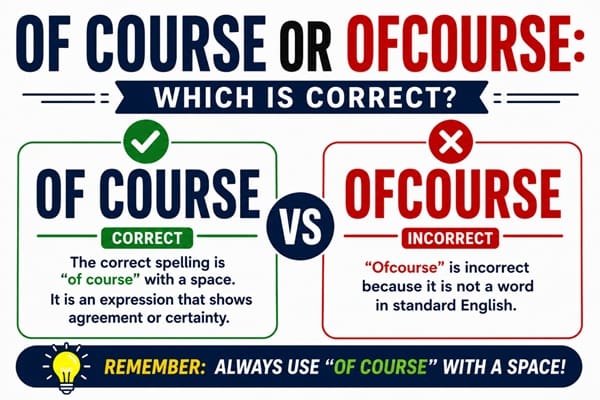
The correct form is of course.
The words must always be written separately.
Correct:
Of course
Incorrect:
Ofcourse
Standard English dictionaries, grammar references, educational institutions, and professional style guides recognize only of course as the proper spelling.
Whenever you write the expression, use two separate words.
What Does Of Course Mean?
The phrase of course is used to express certainty, agreement, politeness, or something that seems obvious.
People often use it when responding positively to a question or confirming information.
For example:
“Can you help me with this project?”
“Of course.”
The phrase can also indicate that something is expected.
Example:
“Of course she passed the exam. She studied every day.”
In both situations, the meaning suggests confidence or certainty.
Why Do People Write Ofcourse?
The mistake usually happens because the phrase is spoken so frequently.
When people say “of course” in conversation, the two words often sound like a single unit. As a result, some writers assume the phrase should be combined into one word.
Fast typing also contributes to the error.
Text messages, online chats, and social media posts encourage speed rather than careful proofreading. Small mistakes can become habits over time.
Another reason involves English spelling patterns. Many compound words exist in the language, leading some people to believe that ofcourse follows the same rule.
Despite these assumptions, standard English keeps the words separate.
The History of the Phrase Of Course
The phrase has been part of English for centuries.
Originally, it referred to something following a natural course or expected path. Over time, the meaning expanded to express certainty, agreement, and logical expectation.
As English evolved, the phrase maintained its two word structure.
Unlike certain expressions that eventually merged into single words, of course remained separated.
That historical consistency explains why modern English continues to treat it as a phrase rather than a standalone word.
Of Course as an Expression of Agreement
One of the most common uses of of course is showing agreement.
People frequently use it in conversations when responding positively.
Examples include:
“May I borrow your book?”
“Of course.”
“Can you attend the meeting tomorrow?”
“Of course.”
The phrase sounds friendly, confident, and polite.
Many speakers prefer it because it feels warmer than a simple yes.
Of Course as an Expression of Certainty
Certainty is another major function of the phrase.
Writers and speakers often use of course when discussing something they consider obvious or expected.
Consider these examples:
“Of course the roads were crowded during the holiday weekend.”
“Of course he remembered the appointment.”
“Of course the team celebrated after winning.”
Each sentence communicates strong confidence in the statement being made.
Of Course in Everyday Conversation
Few English phrases appear more often in daily communication.
Friends use it when offering help.
Parents use it when answering questions.
Teachers use it when explaining concepts.
Customer service representatives frequently rely on it when assisting customers.
Because the phrase appears in so many situations, mastering the correct spelling becomes especially important.
Of Course in Professional Communication
Business communication requires clarity and professionalism.
Emails, reports, presentations, and workplace conversations often include the phrase.
Examples include:
“Of course, we can schedule another meeting.”
“Of course, I will review the document.”
“Of course, our team is available to assist.”
Using the correct spelling helps maintain a polished professional image.
A misspelling like ofcourse can make otherwise strong writing appear less careful.
Of Course in Academic Writing
Academic writing generally favors precise language.
Students occasionally use of course when presenting logical conclusions or discussing established facts.
For example:
“Of course, additional research is necessary to confirm the findings.”
Many instructors encourage moderation because overusing the phrase can make arguments seem less objective.
Still, when used appropriately, it remains a valid part of academic English.
Correct spelling remains essential in educational settings.
Common Examples of Of Course
Examples help reinforce proper usage.
“Of course I remember your birthday.”
“Of course we can discuss the issue tomorrow.”
“Of course the project required careful planning.”
“Of course she was excited about the opportunity.”
“Of course the audience applauded after the performance.”
Every example uses the two word form.
No standard English sentence would use ofcourse.
Is Ofcourse a Real Word?
No.
Ofcourse is not recognized as a standard English word.
You will not find it listed as a proper entry in respected dictionaries.
Occasional appearances online usually result from typing mistakes, spelling errors, or misunderstandings.
Writers should avoid using ofcourse in formal, academic, business, or professional communication.
The correct version is always of course.
Why Correct Spelling Matters
Spelling influences how readers perceive your writing.
A correctly written document appears more polished and trustworthy.
Small mistakes may seem unimportant, but they can affect first impressions.
Employers, teachers, clients, and readers often notice errors in commonly used expressions.
Since of course appears frequently, its spelling becomes particularly visible.
Using the correct form demonstrates attention to detail.
Common Mistakes Related to Of Course
Several errors appear regularly.
The most common is combining the words into ofcourse.
Some writers accidentally use unnecessary punctuation.
Others capitalize the phrase incorrectly in the middle of sentences.
A few people overuse the expression, weakening its impact.
Careful proofreading helps prevent these mistakes and improves overall writing quality.
Of Course vs Certainly
Many people wonder whether of course and certainly mean the same thing.
The meanings are similar but not identical.
Certainly often sounds more formal.
Of course feels warmer and more conversational.
Consider these responses:
“Certainly, I can help you.”
“Of course, I can help you.”
Both are correct, but the second version often sounds friendlier.
Choosing between them depends on context and tone.
Of Course vs Obviously
Although both expressions suggest certainty, they create different impressions.
Obviously can sometimes sound dismissive or overly direct.
Of course generally feels more polite.
For example:
“Obviously, the answer is correct.”
“Of course, the answer is correct.”
The second version often sounds more natural in everyday conversation.
Tone matters as much as meaning when selecting the right phrase.
Also Read : Connector or Connecter: Which Spelling Is Correct? Complete Guide
Of Course in Digital Communication
Texting, messaging apps, and social media have increased the frequency of informal writing.
Quick responses often lead to spelling shortcuts and typing mistakes.
Many people accidentally write ofcourse while typing rapidly.
Autocorrect tools sometimes catch the error, but not always.
Reviewing messages before sending them can help maintain accuracy.
Even casual communication benefits from correct spelling.
Why English Learners Struggle with Of Course
English learners often encounter confusion because the phrase functions almost like a single unit in speech.
Listening exercises may not clearly reveal the space between the words.
Certain languages create similar expressions as one word, which can influence spelling habits.
Frequent reading helps learners recognize the correct form.
Exposure to professionally written English strengthens familiarity over time.
Consistent practice eventually makes the correct spelling automatic.
Memory Tricks to Remember the Correct Form
Simple memory techniques can prevent future mistakes.
One useful trick is to focus on the word “of.”
Many English phrases beginning with “of” remain separate.
Examples include:
Of interest
Of value
Of importance
Of course
Thinking about these examples reinforces the pattern.
Another helpful approach involves visual memory. Seeing the phrase written correctly repeatedly makes the proper form easier to recall.
The Role of Of Course in Polite Communication
Politeness plays a significant role in the phrase’s popularity.
Responses such as “of course” often sound more welcoming than short answers.
Someone asking for assistance may appreciate the warmth conveyed by the expression.
Customer service professionals frequently use it because it reassures people.
Teachers, managers, and leaders also rely on the phrase to create positive interactions.
Language influences relationships, and small expressions often make a noticeable difference.
Frequently Asked Questions About Of Course and Ofcourse
One common question asks whether ofcourse is accepted anywhere in English.
The answer is no. Standard English uses of course exclusively.
Another question concerns capitalization.
Capitalize the phrase only when it begins a sentence or appears in a title.
Writers also ask whether the phrase is formal or informal.
Of course works in both settings, though context determines how frequently it should be used.
Understanding these details helps improve confidence and accuracy.
Conclusion
The answer to the of course or ofcourse question is simple. Of course is the correct spelling, while ofcourse is a common mistake.
English treats the expression as a two word phrase, not a single word. Whether you are writing an email, completing a school assignment, posting on social media, or preparing a professional document, the correct form remains the same.
Because the phrase appears so often in everyday communication, mastering its spelling is an easy way to strengthen writing quality. Careful proofreading, regular reading, and consistent practice can help eliminate the error completely.
Once you remember that the words stay separate, choosing the correct version becomes second nature.