English contains many words that sound similar but carry completely different meanings. Among the most commonly confused combinations is other than or other then. Because the words than and then sound alike in casual speech, many people accidentally use the wrong phrase in writing.
A single letter can change the meaning of a sentence. Using the correct phrase helps readers understand your message clearly and makes your writing appear more polished and professional. Whether you are writing emails, academic papers, blog posts, business documents, or social media content, knowing the difference between other than and other then is an essential grammar skill.
The reality is simple. In most situations, other than is the correct phrase. The phrase other then is usually a mistake. Understanding why requires learning the difference between the words than and then first.
This guide covers everything you need to know, including definitions, grammar rules, examples, memory tricks, common errors, and practical usage in everyday English.
Contents
- 1 Understanding the Meaning of Other Than
- 2 Understanding the Meaning of Then
- 3 Why Other Then Is Usually Incorrect
- 4 The Core Difference Between Than and Then
- 5 How Other Than Functions in Grammar
- 6 Common Situations Where Other Than Is Used
- 7 Other Than in Everyday Conversations
- 8 Other Than in Professional Writing
- 9 Other Than in Academic Writing
- 10 Common Mistakes Involving Other Than
- 11 Can Other Then Ever Be Correct?
- 12 Memory Tricks to Remember the Difference
- 13 Examples of Other Than in Sentences
- 14 Examples Showing the Difference Between Than and Then
- 15 Why Grammar Accuracy Matters
- 16 How Search Engines and Readers View Grammar Errors
- 17 Learning Similar Word Pairs
- 18 Final Thoughts
Understanding the Meaning of Other Than
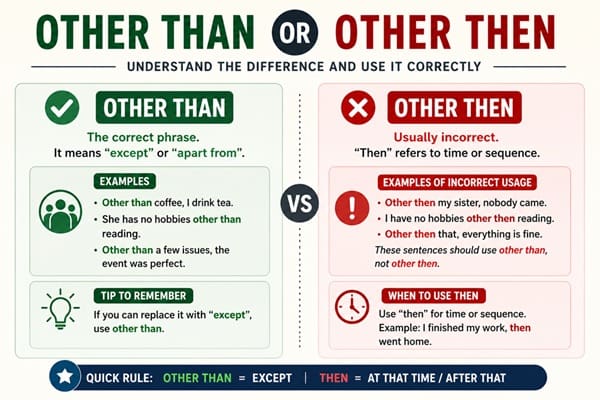
The phrase other than means except for, apart from, besides, or different from.
Writers use it when excluding something from a group or making a distinction between one thing and another.
Consider these examples:
Other than coffee, I do not drink caffeinated beverages.
She has no hobbies other than reading.
Other than a few minor issues, the project went smoothly.
Nobody other than the manager can approve the request.
In each example, the phrase identifies an exception or distinction. The meaning remains clear because than is used for comparison and differentiation.
That is why other than is considered a standard and correct English expression.
Understanding the Meaning of Then
The word then relates to time, sequence, or what happens next.
It is commonly used when describing events in order.
Examples include:
Finish your homework, then watch television.
We arrived at the airport and then checked in.
The meeting ended, and then everyone went home.
First mix the ingredients, then bake the cake.
Notice that then tells readers when something happens or what follows another action.
It does not normally create comparisons or exceptions.
Because of this difference, then rarely belongs after the word other.
Why Other Then Is Usually Incorrect
The phrase other then appears frequently online, but it is generally considered a grammatical error.
The mistake happens because people confuse than and then.
For example:
Incorrect: Other then math, science is my favorite subject.
Correct: Other than math, science is my favorite subject.
The sentence is discussing an exception, not a sequence of events. Since the meaning involves exclusion, than is required.
Whenever you mean except, apart from, or besides, the correct phrase is other than.
The Core Difference Between Than and Then
Understanding the individual words makes everything easier.
Than is used for comparison.
Examples:
She is taller than her sister.
The movie was better than expected.
Nothing matters more than family.
Then is used for time and sequence.
Examples:
Eat dinner, then wash the dishes.
He graduated and then started a business.
The rain stopped, then the sun appeared.
A simple rule can solve most confusion.
If the sentence involves comparison, difference, exclusion, or exception, use than.
If the sentence involves time or order, use then.
How Other Than Functions in Grammar
Other than typically acts as a preposition or conjunction.
Its primary role is to introduce an exception.
Consider these sentences:
Other than traffic, the trip was pleasant.
Other than her brother, nobody knew the secret.
Other than weekends, the store is open daily.
Each sentence removes something from a larger group.
The phrase functions smoothly because it communicates exclusion.
Many grammar experts compare its meaning to words like except, apart from, and excluding.
Common Situations Where Other Than Is Used
The phrase appears in many everyday situations.
People use it when discussing preferences.
Other than pizza, I enjoy most foods.
Writers use it when describing exceptions.
Other than one mistake, the report was excellent.
Businesses use it when explaining policies.
Other than authorized personnel, nobody may enter the building.
Students use it in academic writing.
Other than climate factors, economic conditions also influenced migration patterns.
The versatility of the phrase explains why it appears so frequently in spoken and written English.
Other Than in Everyday Conversations
Daily conversations often include this phrase without people consciously noticing it.
Someone might say:
Other than work, what do you do for fun?
Other than your phone, what did you bring?
Other than that issue, everything looks great.
These examples show how naturally the phrase fits into casual speech.
Native speakers use it regularly because it quickly communicates exceptions and distinctions.
Other Than in Professional Writing
Professional communication values clarity.
Using the correct phrase helps avoid misunderstandings.
Examples include:
Other than the requested revisions, the proposal meets all requirements.
Other than scheduling conflicts, there are no major concerns.
Other than approved expenses, reimbursements will not be processed.
Business writing often relies on precise language, making correct usage especially important.
Other Than in Academic Writing
Students frequently encounter other than in essays, reports, and research papers.
Examples include:
Other than population growth, several factors contributed to urban expansion.
Other than the control group, all participants received treatment.
Other than language differences, the cultures share many similarities.
Academic writing demands grammatical accuracy, so understanding this phrase is valuable for students at every level.
Common Mistakes Involving Other Than
One frequent error is replacing than with then.
Incorrect:
Other then my brother, nobody attended.
Correct:
Other than my brother, nobody attended.
Another mistake involves unnecessary repetition.
Incorrect:
Other than except John, nobody came.
Correct:
Other than John, nobody came.
Since other than already expresses exclusion, adding except creates redundancy.
Clear writing avoids such repetition.
Can Other Then Ever Be Correct?
Although it is usually incorrect, there are rare situations where the words other and then may appear together naturally.
For example:
I had no other option then available.
In this sentence, other modifies option, while then functions independently as a time reference.
However, this is not the phrase “other then” functioning as a unit.
Most of the time, when writers type “other then,” they actually mean “other than.”
That is why grammar checkers frequently flag the expression.
Memory Tricks to Remember the Difference
Simple memory techniques can prevent mistakes.
Think about the letter A in than.
The letter A can remind you of comparison and alternatives.
When discussing exceptions or differences, choose than.
Think about the letter E in then.
The letter E can remind you of events.
When discussing time or sequence, choose then.
Another easy trick involves asking a question.
Can I replace the phrase with except?
If yes, use other than.
Example:
Other than coffee, I drink tea.
Except for coffee, I drink tea.
The sentence still works, confirming that other than is correct.
Examples of Other Than in Sentences
Seeing examples in context helps reinforce learning.
Other than rain, the forecast looks clear.
Other than her parents, nobody knew the news.
Other than English, he speaks Spanish and French.
Other than transportation costs, the trip was affordable.
Other than a brief delay, everything proceeded according to schedule.
Other than one chapter, I finished the entire book.
Other than weekends, the library remains open every day.
Other than experience, employers also value communication skills.
Each sentence demonstrates exclusion or distinction rather than sequence.
Also Read : Pre vs Post Meaning Explained: Differences, Examples, Usage Guide, and Common Mistakes
Examples Showing the Difference Between Than and Then
Comparison examples using than:
She runs faster than I do.
The second option is cheaper than the first.
Learning is more valuable than memorization.
Sequence examples using then:
Finish the introduction, then write the conclusion.
He completed training and then accepted the job offer.
The lights flickered, then went out completely.
Understanding these patterns makes choosing the correct word much easier.
Why Grammar Accuracy Matters
Small grammar mistakes can affect how readers perceive your writing.
A sentence containing “other then” may distract readers or create doubts about accuracy.
Professional communication often depends on attention to detail.
Academic writing requires grammatical correctness.
Content creators benefit from producing polished material.
Correct word choice improves readability and credibility.
While readers may still understand your intended meaning, using the proper phrase demonstrates stronger language skills.
How Search Engines and Readers View Grammar Errors
Well-written content generally provides a better reading experience.
Readers are more likely to trust information that appears carefully written and edited.
Frequent grammar mistakes can reduce engagement and create confusion.
Content that uses correct language tends to feel more authoritative and professional.
For bloggers, students, marketers, and business owners, grammar accuracy contributes to stronger communication.
Learning Similar Word Pairs
The confusion between other than and other then belongs to a larger group of commonly mixed-up words.
Examples include:
Their and there.
Your and you’re.
Accept and except.
Affect and effect.
Than and then.
Recognizing the meaning and function of each word helps eliminate mistakes before they happen.
Developing this habit improves overall writing quality.
Final Thoughts
The difference between other than or other then becomes easy once you understand the roles of than and then. The phrase other than means except for, apart from, or different from. It is the correct choice in nearly every situation where an exclusion or comparison is being made.
The word then relates to time, sequence, and what happens next. Because of this meaning, it rarely works after the word other as part of a fixed phrase.
Whenever you are unsure, try replacing the phrase with except for. If the sentence still makes sense, other than is almost certainly the correct option.
Mastering this distinction strengthens grammar skills, improves writing confidence, and helps create clearer communication in academic, professional, and everyday settings.