
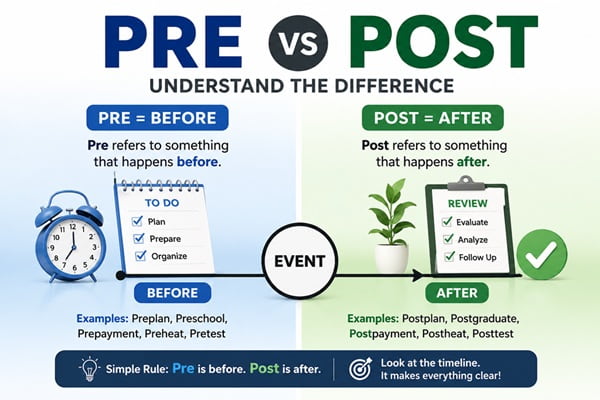
Language becomes easier to understand when you know how words are formed. Many English words contain prefixes that change the meaning of a base word. Among the most common prefixes are pre and post. These two simple word parts appear in thousands of words used in everyday conversations, academic writing, medicine, business, history, science, and technology.
Terms such as preschool, prepayment, postwar, postgraduate, and postmortem are so common that many people use them without thinking about their meaning. Yet understanding the difference between pre and post can significantly improve your vocabulary, reading skills, writing accuracy, and overall communication.
Although these prefixes are small, they carry a powerful meaning. They help identify whether something happens before or after a specific event, action, or period. Once you understand this basic concept, recognizing and interpreting countless English words becomes much easier.
This complete guide explains everything you need to know about pre vs post, including definitions, origins, usage rules, examples, common mistakes, and practical applications.
Contents
- 1 Understanding the Prefix Pre
- 2 Understanding the Prefix Post
- 3 The Fundamental Difference Between Pre and Post
- 4 Where Do Pre and Post Come From?
- 5 Common Words Using Pre
- 6 Common Words Using Post
- 7 Pre vs Post in Education
- 8 Pre vs Post in Medicine
- 9 Pre vs Post in Business
- 10 Pre vs Post in Research
- 11 Pre vs Post in Sports
- 12 Pre vs Post in Technology
- 13 Why Understanding Pre and Post Matters
- 14 Common Mistakes People Make
- 15 Easy Memory Tricks
- 16 How Pre and Post Improve Vocabulary
- 17 Pre vs Post in Everyday Life
- 18 Final Thoughts
Understanding the Prefix Pre
The prefix pre means before, prior to, ahead of, or earlier than something else.
Whenever you see pre attached to a word, it usually indicates that an action, event, condition, or stage occurs before another event.
Consider these examples:
A preschool is designed for children before they enter primary school.
A pregame meeting takes place before a sporting event starts.
A prepaid service is paid for before it is used.
A preexisting condition refers to a medical condition that existed before a particular event or treatment.
In every example, the prefix points to something happening in advance. It creates a clear relationship with time and sequence.
Because of its usefulness, pre is one of the most widely used prefixes in English. It appears in both formal and informal communication and continues to be used in newly created words.
Understanding the Prefix Post
The prefix post means after, following, or later than something.
Words beginning with post describe events, conditions, or actions that occur after a particular point in time.
Examples include:
A postgame interview happens after a game ends.
Postgraduate studies begin after completing an undergraduate degree.
Postwar recovery refers to rebuilding efforts after a war.
A postmortem examination occurs after death.
Unlike pre, which focuses on preparation or anticipation, post focuses on results, consequences, follow-up actions, or later stages.
The prefix appears across many industries and subjects because discussing what happens after an event is just as important as discussing what happens before it.
The Fundamental Difference Between Pre and Post
The simplest way to understand the difference is through time.
Pre refers to what happens before an event.
Post refers to what happens after an event.
Imagine a wedding ceremony.
The preparations, rehearsals, invitations, and planning activities are all pre-wedding activities.
The reception, photo sharing, thank-you messages, and anniversary celebrations are post-wedding activities.
Everything depends on the reference point. The wedding itself serves as the dividing line.
This same principle applies in education, medicine, business, sports, and everyday life.
Where Do Pre and Post Come From?
Both prefixes have roots in Latin.
The prefix pre comes from the Latin word prae, meaning before.
The prefix post comes directly from the Latin word post, meaning after.
English adopted these prefixes centuries ago, and they remain highly productive today.
Many scientific, medical, legal, and academic terms still rely on these Latin roots. Understanding them can help you decode unfamiliar words without looking them up.
Common Words Using Pre
Many everyday words contain the prefix pre.
Preschool refers to education before elementary school.
Preview means viewing something before its official release.
Predict means saying what will happen before it occurs.
Prepare means getting ready before an event.
Preheat means heating something before cooking.
Preorder means ordering a product before it becomes available.
Prevent means stopping something before it happens.
Precaution refers to action taken before danger occurs.
Prearranged means organized beforehand.
Premature means happening earlier than expected.
Each of these examples reflects the central meaning of before.
Common Words Using Post
Many frequently used words contain the prefix post.
Postgraduate refers to education after a bachelor’s degree.
Postwar describes the period following a war.
Postscript is additional information added after the main text of a letter.
Postpone means moving something to a later time.
Postnatal refers to the period after childbirth.
Postmortem means occurring after death.
Postseason refers to competitions that take place after a regular sports season.
Postproduction describes editing and finishing work after filming.
Postoperative refers to the recovery period after surgery.
Postevent analysis examines what happened after an event.
Every example reflects the idea of after.
Pre vs Post in Education
Education provides some of the clearest examples of these prefixes.
Students often encounter terms such as pretest and posttest.
A pretest is given before instruction begins. Its purpose is to measure existing knowledge.
A posttest is given after instruction ends. It measures what students learned.
Similarly, preschool education occurs before formal schooling.
Postgraduate education occurs after earning an undergraduate degree.
Educational researchers frequently compare pre and post results to evaluate learning outcomes.
Pre vs Post in Medicine
Medical professionals use these prefixes extensively.
Preoperative care refers to the preparation before surgery.
Postoperative care refers to treatment and recovery after surgery.
Prenatal care involves monitoring a mother and baby before birth.
Postnatal care focuses on health after childbirth.
Preexisting conditions describe illnesses that existed before a medical event or insurance policy.
Post-treatment evaluations examine recovery after treatment ends.
Understanding these terms helps patients communicate more effectively with healthcare providers.
Pre vs Post in Business
Businesses use these prefixes to describe various stages of customer interactions and operations.
Pre-sales activities occur before a purchase. Examples include demonstrations, consultations, and product presentations.
Post-sales support occurs after a purchase. Examples include technical support, training, and customer service.
Pre-launch marketing promotes a product before release.
Post-launch analysis evaluates performance after launch.
Organizations rely on both stages to create successful customer experiences.
Pre vs Post in Research
Researchers frequently use pre and post measurements.
A pre-study assessment establishes a baseline before an intervention.
A post-study assessment measures outcomes afterward.
For example, a fitness researcher may record participants’ weight before a training program and again after completion.
The comparison between pre and post results helps determine effectiveness.
This approach is widely used in healthcare, psychology, education, and social sciences.
Pre vs Post in Sports
Sports organizations often divide activities into pre and post phases.
Pregame activities include warm-ups, strategy discussions, and team meetings.
Postgame activities include interviews, performance reviews, and celebrations.
Fans also encounter terms like postseason, which refers to competitions held after the regular season concludes.
Sports commentators regularly discuss both pregame expectations and postgame reactions.
Pre vs Post in Technology
Technology companies frequently use these prefixes.
Preinstallation refers to software installed before a device reaches customers.
Preconfigured systems come with settings established in advance.
Post-installation tasks occur after setup.
Post-deployment monitoring takes place after software launches.
Developers often conduct pre-release testing and post-release maintenance.
These terms help organize workflows and project stages.
Why Understanding Pre and Post Matters
Learning these prefixes offers benefits beyond vocabulary growth.
Readers can understand unfamiliar words more easily.
Writers can communicate ideas with greater precision.
Students improve reading comprehension.
Professionals can better understand industry-specific terminology.
Language learners gain confidence because they recognize predictable patterns.
Knowing a few prefixes often unlocks the meaning of hundreds of related words.
Common Mistakes People Make
Many learners confuse pre and post because the words often appear in similar contexts.
One common mistake is reversing the timeline.
For example, calling a meeting after a project a pre-project meeting is incorrect. Since it occurs afterward, it would be considered a post-project meeting.
Another mistake involves assuming every word beginning with pre or post follows the exact timing rule. While most do, some specialized terms require understanding the complete word.
Context remains important.
Reading the full sentence usually clarifies meaning.
Also Read : ASH Meaning in Text: What Does ASH Mean on Snapchat, TikTok, and Social Media?
Easy Memory Tricks
Simple memory techniques can make these prefixes easier to remember.
Think of pre as preparation.
Preparation always happens before something important.
Think of post as follow-up.
Follow-up activities occur after the main event.
Another useful trick involves alphabet order.
The letter E in pre can remind you of earlier.
The letter O in post can remind you of afterward or ongoing outcomes.
These mental shortcuts help reinforce the difference.
How Pre and Post Improve Vocabulary
Prefix knowledge acts like a vocabulary shortcut.
Instead of memorizing every word individually, you learn patterns.
When encountering a new word such as preauthorization, you can immediately infer that authorization occurs before something else.
Likewise, postassessment suggests an assessment performed afterward.
This skill saves time and increases reading efficiency.
Many advanced readers rely on prefix recognition to understand unfamiliar terms quickly.
Pre vs Post in Everyday Life
People use these prefixes more often than they realize.
A pre-trip checklist is completed before traveling.
A post-trip review reflects on the experience afterward.
Preworkout supplements are taken before exercise.
Postworkout recovery occurs after exercise.
Prebooking secures reservations before an event.
Postevent feedback gathers opinions after completion.
Daily life contains countless examples of this before-and-after relationship.
Final Thoughts
The difference between pre vs post is simple once you understand the timing involved. Pre means before, while post means after. These prefixes appear across education, medicine, business, technology, sports, research, and everyday communication.
Recognizing them helps decode unfamiliar words, strengthens vocabulary, improves reading comprehension, and enhances writing accuracy. Rather than memorizing hundreds of individual terms, learning the meaning of these prefixes gives you a practical tool for understanding thousands of words.
Whether you encounter a preschool program, a prepayment plan, a postoperative recovery period, or a postgraduate degree, the same principle applies. Pre points to what comes before. Post points to what comes after.
Mastering this simple distinction makes English clearer, more logical, and much easier to navigate.