
Contents
- 1 Introduction to SYBAU in Internet Language
- 2 What is SYBAU Meaning in Text and Chat
- 3 Origin and Rise of SYBAU Slang
- 4 What SYBAU Stands For in Different Contexts
- 5 How SYBAU Is Used in Online Conversations
- 6 Emotional Tone and Intent Behind SYBAU
- 7 Why SYBAU Became Popular Online
- 8 Is SYBAU Offensive or Just Slang
- 9 Misunderstandings Around SYBAU Meaning
- 10 Examples of SYBAU in Conversation
- 11 Safe Alternatives to SYBAU
- 12 Should You Use SYBAU in Online Communication
- 13 SYBAU and Its Place in Internet Slang Culture
- 14 Conclusion
Introduction to SYBAU in Internet Language
Internet slang changes fast, and new abbreviations often appear without warning across chats, gaming lobbies, and short video platforms. One such term that has raised curiosity is “SYBAU meaning.” At first glance, it looks confusing because it is not a standard English word and does not appear in formal dictionaries.
SYBAU is part of a growing trend where users shorten strong expressions into acronyms to react quickly in conversations. It carries an aggressive tone and is mostly used in informal digital spaces where people joke, argue, or react emotionally. Understanding it requires more than just decoding letters; context plays a major role in how it is used and interpreted.
This slang reflects how online communication has shifted toward speed, emotion, and brevity. Instead of typing full sentences, users rely on compact expressions that instantly deliver attitude or reaction.
What is SYBAU Meaning in Text and Chat
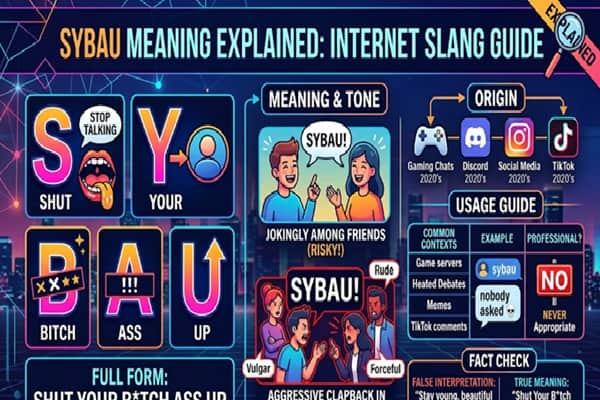
The most widely accepted SYBAU meaning in text is “Shut Your B*** Ass Up.” It is an abbreviated form used to tell someone to stop talking in a rude or aggressive way.
This phrase is not polite and is generally considered offensive. However, in online slang culture, it is often used jokingly between friends or in heated arguments where exaggeration is part of the communication style.
The phrase is similar in intent to other internet insults, but its shortened form makes it feel faster and more impactful in chat environments. People use it when emotions are high or when they want to shut down a conversation quickly.
Despite its rough tone, SYBAU is not always meant to be serious. In many online spaces, tone depends heavily on context, emojis, and the relationship between users.
Origin and Rise of SYBAU Slang
SYBAU did not originate from formal language or traditional slang dictionaries. It emerged from online communities where users frequently shorten strong phrases into acronyms.
Gaming platforms and meme communities played a major role in spreading it. Fast-paced chats encouraged users to create abbreviations that could be typed quickly during gameplay or heated discussions.
As short-form video platforms grew, creators started using SYBAU in captions, comments, and reaction clips. This exposure helped the slang spread beyond gaming into general social media culture.
The rise of acronym-based communication also contributed to its popularity. Similar to terms like “LOL” or “STFU,” SYBAU fits into a pattern where emotional phrases are compressed into short, reusable codes.
What SYBAU Stands For in Different Contexts
While the most common interpretation of SYBAU is “Shut Your B*** Ass Up,” its exact meaning can vary slightly depending on context and community usage.
In some cases, users may soften the phrase mentally and interpret it as a playful or exaggerated version of “be quiet.” In others, it is taken literally as an insult.
The flexibility of meaning is what keeps slang alive online. Users often adjust tone based on conversation flow, making SYBAU either humorous or offensive depending on delivery.
However, the core idea remains consistent. It is a forceful way of telling someone to stop speaking.
How SYBAU Is Used in Online Conversations
SYBAU appears mostly in informal digital environments such as group chats, comment sections, gaming lobbies, and meme replies. Its usage is quick and reactive rather than planned.
In gaming, it may appear after a teammate makes a mistake or when opponents try to provoke each other. In social media comment threads, it is often used during arguments or sarcastic exchanges.
The abbreviation helps users express frustration without typing a full sentence. This speed-driven communication style is common in environments where multiple messages appear at once.
Even though the phrase is short, its impact is strong due to its aggressive tone and cultural recognition among younger internet users.
Emotional Tone and Intent Behind SYBAU
SYBAU carries a strong emotional charge. It is not neutral language and usually reflects irritation, anger, or sarcasm.
In some cases, users apply it jokingly among friends where the insult is not meant to be taken seriously. In these situations, tone indicators like emojis or laughter cues often soften the message.
However, without context, the phrase can easily come across as disrespectful. Unlike mild slang, SYBAU sits in a more intense category of internet language.
Understanding intent is key. The same acronym can either end a heated argument or simply act as playful banter depending on how it is delivered.
Why SYBAU Became Popular Online
The popularity of SYBAU is tied to how modern digital communication works. Short, impactful expressions spread quickly because they are easy to remember and easy to type.
Acronyms also create a sense of belonging within online communities. People who understand the slang feel part of an in-group, while others may feel excluded until they learn its meaning.
Memes and reaction content further amplified its reach. Once a slang term appears in viral videos or popular comment threads, it gains momentum rapidly.
The simplicity of SYBAU makes it reusable across different situations, which helps it stay active in online conversations.
Is SYBAU Offensive or Just Slang
SYBAU is generally considered offensive due to its full meaning. The phrase it represents contains strong language that is not appropriate for formal or polite communication.
However, internet culture often blurs the line between insult and humor. Among close friends or within meme culture, it may be used jokingly without serious intent.
Despite this flexibility, caution is important. Using SYBAU in professional, academic, or unfamiliar settings can create misunderstanding or conflict.
The safest approach is to understand it as strong slang that should be used carefully and only in appropriate contexts.
Misunderstandings Around SYBAU Meaning
Many people first encounter SYBAU without knowing what it stands for. This leads to confusion and different interpretations.
Some assume it is a harmless abbreviation without realizing its full phrase. Others mistake it for a random string of letters with no meaning at all.
Misunderstandings often happen because slang evolves faster than explanations spread. New users join platforms daily and encounter terms before learning their background.
This gap between usage and understanding is a common feature of internet language evolution.
Examples of SYBAU in Conversation
In a chat between friends during a game, one player might say something like SYBAU after another makes a bold but incorrect claim. In this case, the tone may be playful rather than serious, depending on their relationship.
In a comment section argument, SYBAU may appear as a direct response to someone trying to provoke others. Here, the tone is sharper and more confrontational.
In meme culture, SYBAU might be used in captions to exaggerate frustration in a humorous way. The context often turns a harsh phrase into entertainment.
These examples show how meaning shifts depending on environment and tone.
Also Read : Tonite vs Tonight: Meaning, Difference, Grammar Rules and Proper Usage Explained
Safe Alternatives to SYBAU
Because SYBAU is strong and potentially offensive, many users prefer softer alternatives. Phrases like “calm down,” “stop talking,” or “relax” deliver similar intent without harsh language.
In casual online settings, humor-based responses often replace aggressive slang. This helps maintain conversation flow without creating conflict.
Choosing neutral language also makes communication clearer across different audiences, especially in mixed-age or public spaces.
Should You Use SYBAU in Online Communication
Using SYBAU depends heavily on context and audience. In private chats with friends who understand the tone, it may not cause issues. In public or professional environments, it is not appropriate.
Digital communication leaves a permanent record, so tone can easily be misunderstood. What feels like a joke in one moment may appear offensive to others later.
Awareness of audience sensitivity helps avoid unnecessary conflict. Slang like SYBAU should always be used with caution and understanding of its impact.
SYBAU and Its Place in Internet Slang Culture
SYBAU is part of a larger ecosystem of internet slang where emotion and speed shape language. Similar acronyms appear regularly as users try to compress strong reactions into short forms.
This type of language reflects how digital spaces prioritize quick interaction over formal structure. Meaning becomes flexible, shaped by community usage rather than grammar rules.
Over time, some slang terms fade while others become widely accepted. SYBAU currently exists in active online circulation, especially among younger users.
Its role is less about linguistic correctness and more about expression, reaction, and digital identity.
Conclusion
The “SYBAU meaning” represents more than just an acronym. It reflects how internet communication transforms strong emotions into short, fast expressions. While its core meaning is aggressive, its usage varies widely depending on tone and context.
Understanding SYBAU helps decode modern online conversations where slang evolves quickly and meaning shifts based on community behavior. It also highlights the importance of reading tone carefully in digital communication.
Clear awareness of when and where to use such slang ensures better interaction and avoids unnecessary misunderstandings. In online spaces, context always shapes meaning more than the words themselves.